ARTICLE
What Is a Birth Chart? A Beginner’s Guide to Kundli and the 12 Houses
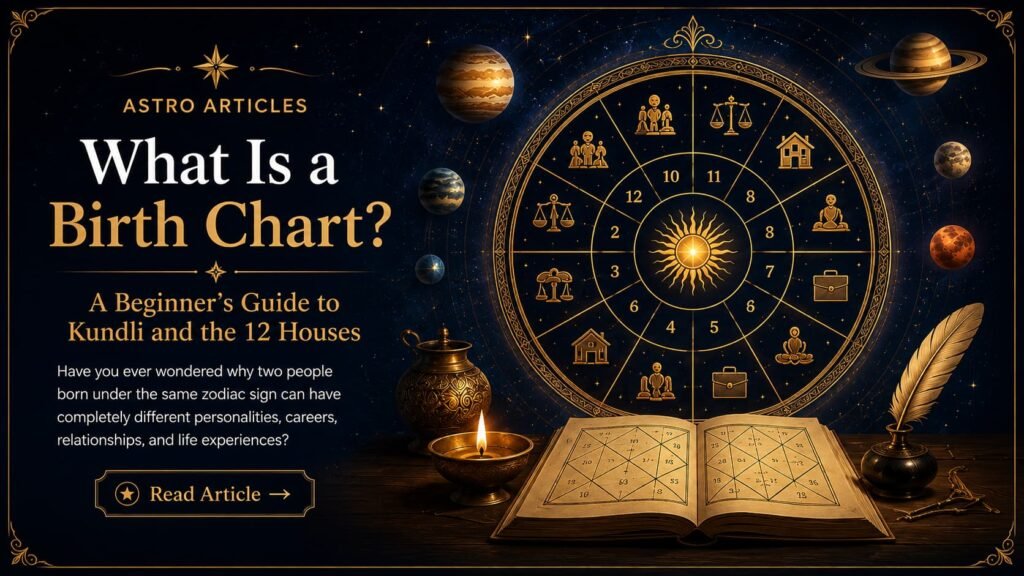
Have you ever wondered why two people born under the same zodiac sign can have completely different personalities, careers, relationships, and life experiences?
In Vedic astrology, your zodiac sign is only one part of a much larger picture. A birth chart, commonly known as a Kundli or Janam Kundli, maps the positions of the planets at the time and place of your birth.
Astrologers traditionally interpret this chart to explore personality, relationships, career tendencies, finances, health themes, spiritual interests, and important periods of life.
If you are new to astrology, understanding the 12 houses of a Kundli is one of the best places to begin.
What Is a Birth Chart or Kundli?
A birth chart is an astrological chart calculated using three important pieces of birth information:
- Date of birth
- Exact time of birth
- Place of birth
These details are used to calculate the positions of the Sun, Moon, planets, Ascendant and other astrological points for the moment of birth.
In Vedic astrology, the chart is divided into 12 houses. Each house represents a different area of life.
However, a house should not normally be interpreted in isolation. Astrologers also consider the zodiac sign occupying the house, its ruling planet, planets placed in the house, planetary aspects, conjunctions, strengths and other chart factors.
Why Is Your Exact Birth Time Important?
Birth time is particularly important because the Ascendant, or Lagna, changes throughout the day.
The Ascendant determines the starting point of the houses in a birth chart. Therefore, an inaccurate birth time can potentially change the Ascendant and house placements used for interpretation.
This is why a reliable birth-chart calculation should ideally use the most accurate birth time available.
Understanding the 12 Houses of a Kundli
Think of the 12 houses as twelve areas of human life.
1st House — Self, Personality and Identity
The first house is commonly associated with the self, physical appearance, personality, temperament and approach to life.
It is also the house of the Ascendant or Lagna.
A strong emphasis on the first house may make themes of personal identity, independence and self-development particularly important in an astrological interpretation.
2nd House — Wealth, Family and Speech
The second house is traditionally connected with accumulated wealth, family, possessions, values, food and speech.
Astrologers may examine this house when considering a person’s relationship with savings, material security, family environment and communication style.
It should not, however, be treated as a guarantee of wealth or financial success.
3rd House — Communication, Courage and Siblings
The third house is associated with communication, courage, initiative, skills, short journeys and younger siblings.
It can also be considered when studying writing, self-expression, practical abilities and the willingness to take initiative.
4th House — Home, Mother and Inner Comfort
The fourth house traditionally represents home, mother, property, domestic life, emotional foundations and inner comfort.
It can describe themes surrounding a person’s sense of belonging, private life and connection with home.
5th House — Creativity, Education and Children
The fifth house is associated with creativity, intelligence, learning, romance, children and self-expression.
It is also traditionally connected with areas such as speculation and past-life merit in some schools of Vedic astrology.
Because financial speculation involves real risk, astrological interpretations should never replace professional financial analysis.
6th House — Work, Service and Challenges
The sixth house relates to themes such as daily work, service, routines, competition, debts, obstacles and disputes.
Traditional astrology also associates this house with illness and health challenges. Astrology should not be used to diagnose or treat medical conditions; health concerns should always be discussed with qualified healthcare professionals.
7th House — Marriage and Partnerships
The seventh house sits opposite the first house and is associated with marriage, committed relationships, partnerships, contracts and one-to-one interactions.
Astrologers often examine the seventh house together with its lord, planets influencing it and other relationship indicators rather than making conclusions from a single placement.
8th House — Transformation, Shared Resources and Mysteries
The eighth house is traditionally connected with transformation, inheritance, shared resources, hidden matters, research and profound changes.
It is sometimes described dramatically as the house of death. A more responsible approach is to understand it primarily as a house involving change, vulnerability and matters that are not always immediately visible.
Astrology should not be used to predict a person’s death.
9th House — Dharma, Wisdom and Long Journeys
The ninth house is associated with dharma, philosophy, higher learning, teachers, spirituality, fortune and long-distance journeys.
It can represent the beliefs and principles through which a person tries to understand the larger meaning of life.
10th House — Career, Work and Public Life
The tenth house is one of the most prominent houses for examining career, responsibilities, profession, reputation and public life.
A career interpretation should consider the whole chart rather than assuming that one planet or one house automatically determines a profession.
Personal skills, education, opportunities and real-world circumstances remain essential.
11th House — Gains, Goals and Networks
The eleventh house is traditionally associated with gains, income, ambitions, social networks, communities and the fulfilment of goals.
It can provide astrologers with additional context when examining a person’s aspirations and connections with larger groups.
12th House — Expenses, Solitude and Spirituality
The twelfth house is associated with expenses, solitude, foreign places, withdrawal, sleep, spiritual practices and letting go.
Although it is sometimes viewed negatively, the twelfth house also has an important contemplative dimension and can relate to periods of retreat, introspection and spiritual exploration.
The 12 Houses at a Glance
Here is a simple way to remember their traditional themes:
1st House: Self and identity
2nd House: Wealth, family and speech
3rd House: Communication and courage
4th House: Home and emotional foundations
5th House: Creativity, learning and children
6th House: Service, routines and challenges
7th House: Marriage and partnerships
8th House: Transformation and shared resources
9th House: Dharma, wisdom and higher learning
10th House: Career and public life
11th House: Gains, goals and networks
12th House: Expenses, solitude and spirituality
Houses and Zodiac Signs Are Not the Same Thing
This is an important distinction for beginners.
A zodiac sign describes a particular astrological quality or mode of expression, while a house represents an area of life.
For example, the tenth house concerns career and public life. The zodiac sign occupying the tenth house and the condition of its ruler can influence how astrologers interpret those career themes.
This is one reason a complete birth chart contains much more information than a Sun-sign horoscope alone.
What Do Planets Represent in a Birth Chart?
In traditional Vedic astrology, different planets are associated with different symbolic principles.
For example:
- Sun (Surya): identity, vitality and authority
- Moon (Chandra): mind, emotions and habits
- Mars (Mangala): energy, courage and action
- Mercury (Budha): communication, learning and intellect
- Jupiter (Guru): wisdom, growth and guidance
- Venus (Shukra): relationships, beauty and pleasures
- Saturn (Shani): discipline, responsibility and endurance
- Rahu: ambition, desire and unconventional experiences
- Ketu: detachment, introspection and spiritual themes
Their interpretations change according to their sign, house, strength, relationships with other planets and the broader chart.
Can One Planet Decide Your Future?
No single placement should be treated as a complete explanation of a person’s life.
Statements such as “Saturn in this house means you will fail” or “Jupiter here guarantees wealth” oversimplify astrology.
A responsible interpretation considers multiple chart factors together and avoids presenting astrological symbolism as guaranteed future events.
Most importantly, a birth chart does not remove personal choice.
Your decisions, circumstances, education, relationships, effort and opportunities all play important roles in shaping your life.
Frequently Asked Questions
Is a Kundli the same as a birth chart?
In common usage, Kundli, Janam Kundli, natal chart and birth chart all refer to an astrological chart created using a person’s birth information, although terminology and chart presentation can vary between astrological traditions.
Can I create a Kundli without my birth time?
Some planetary positions can still be calculated from a birth date, but an unknown or inaccurate birth time can make the Ascendant and house positions unreliable.
For a detailed house-based interpretation, accurate birth time is highly valuable.
Which house represents career?
The 10th house is traditionally the principal house associated with career, profession, responsibilities and public reputation. Astrologers usually examine several additional factors before interpreting career potential.
Which house represents marriage?
The 7th house is traditionally associated with marriage and committed partnerships. A complete relationship analysis considers other planets and chart factors as well.
Which house represents money?
Several houses may be considered in financial interpretations. The 2nd house is traditionally associated with accumulated wealth and possessions, while the 11th house is associated with gains and income. Financial decisions should be based on appropriate real-world financial information rather than astrology alone.
Final Thoughts
Learning the 12 houses is an excellent foundation for understanding Vedic astrology.
Instead of thinking of a Kundli as a simple prediction of what will happen, it can be approached as a traditional symbolic framework through which astrologers explore different areas of life.
Once you understand what each house represents, the next step is learning how planets, zodiac signs, house lords and aspects interact within the birth chart.
That is where the deeper study of Vedic astrology begins.
Astrology content on Daily Astro Hub is provided for informational, cultural and entertainment purposes and should not replace professional medical, financial, legal or other expert advice.