ARTICLE
5 Timeless Life Lessons from the Mahabharata That Still Matter Today
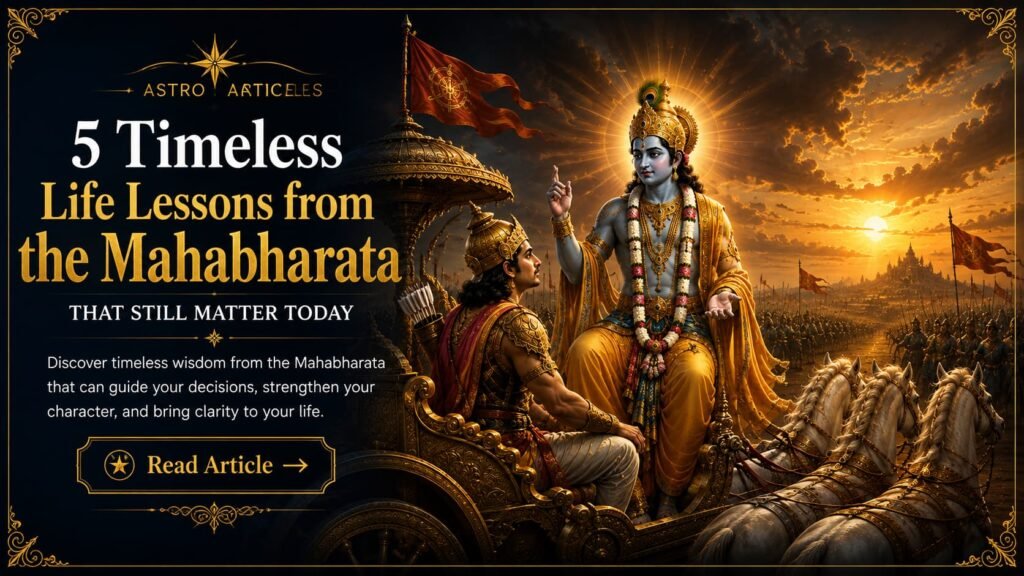
The Mahabharata is much more than the story of a great war.
Behind the kingdoms, warriors, rivalries and extraordinary events lies a profound exploration of human nature. The epic repeatedly confronts questions that remain relevant today:
What is the right thing to do when every choice has consequences? How should we respond to anger, ambition and injustice? What happens when loyalty conflicts with conscience? And why can even intelligent and powerful people make disastrous decisions?
Through figures such as Krishna, Arjuna, Yudhishthira, Bhishma, Karna and Duryodhana, the Mahabharata presents situations in which right and wrong are rarely as simple as they first appear.
Here are five timeless lessons we can reflect on in everyday life.
1. Dharma Is Not Always the Easiest Choice
One of the central ideas running through the Mahabharata is Dharma.
Dharma can broadly refer to duty, righteousness, ethical responsibility and living according to principles appropriate to one’s circumstances.
But the Mahabharata does not present Dharma as a simple checklist.
Again and again, its characters encounter situations in which different duties conflict.
Arjuna’s crisis before the Kurukshetra war is one of the most famous examples.
He sees teachers, relatives and people he respects standing on the opposing side. The conflict is no longer simply about winning a kingdom. He is forced to confront a deeper question:
What should a person do when personal emotions and perceived duty point in different directions?
Krishna’s dialogue with Arjuna becomes the setting for the Bhagavad Gita.
Lesson for everyday life
Doing what is convenient and doing what we believe is right are not always the same thing.
Important decisions may require us to consider:
- our responsibilities
- our values
- the consequences for others
- our motivations
- the long-term effects of our actions
The Mahabharata encourages reflection before action rather than blindly following emotion or convenience.
2. Uncontrolled Ambition Can Destroy What You Already Have
Duryodhana possessed status, power and privilege.
Yet his resentment toward the Pandavas and his unwillingness to accept their prosperity became increasingly destructive.
His problem was not simply ambition.
Ambition can motivate people to learn, build and improve their lives.
The danger arises when ambition becomes inseparable from jealousy, entitlement and the need to defeat someone else.
Instead of appreciating what he possessed, Duryodhana increasingly defined success through what the Pandavas should not possess.
The consequences eventually affected an entire kingdom.
Lesson for everyday life
Comparison can quietly turn achievement into dissatisfaction.
Today this can happen through:
- career comparisons
- money
- social status
- relationships
- business competition
- social media
- lifestyle comparisons
There will almost always be someone with more wealth, recognition or success.
Healthy ambition asks:
“How can I improve?”
Destructive envy asks:
“Why should that person have what I don’t?”
The difference can completely change our decisions.
3. Skill Without Wise Judgment Is Not Enough
The Mahabharata contains extraordinary warriors and highly knowledgeable leaders.
But intelligence, strength and talent do not automatically produce good decisions.
Karna is one of the epic’s most complex examples.
He is remembered for courage, generosity, loyalty and exceptional martial ability. At the same time, his loyalty to Duryodhana places him on a path involving difficult moral choices.
This is one reason Karna continues to fascinate readers.
His story cannot easily be reduced to “good” or “bad.”
It raises a much harder question:
Can loyalty remain virtuous when the person or cause we support is acting wrongly?
Lesson for everyday life
Being talented does not remove the need for judgment.
A person may be:
- highly educated
- technically brilliant
- courageous
- wealthy
- influential
and still make damaging choices.
Skills determine what we can do.
Values and judgment influence what we choose to do.
Both matter.
4. Silence in the Face of Wrongdoing Has Consequences
One of the most disturbing episodes in the Mahabharata is the humiliation of Draupadi after the dice game.
The episode is powerful partly because the wrongdoing does not occur in isolation.
Many respected and powerful people are present.
Some recognize that something is deeply wrong, yet the situation is allowed to continue.
This raises an uncomfortable ethical question:
What responsibility do people have when they witness injustice but do nothing?
The Mahabharata repeatedly shows that consequences arise not only from direct actions but also from failures of judgment, courage and intervention.
Lesson for everyday life
We often think morality is only about avoiding bad actions ourselves.
But sometimes the more difficult question is what we do when we see something wrong happening around us.
This might occur:
- at work
- within a family
- among friends
- in business
- online
- within a community
Intervention should be thoughtful and safe. Not every situation requires confrontation, and serious situations may require appropriate authorities or professional support.
But indifference can also have consequences.
The Mahabharata reminds us that knowing something is wrong and responding wisely to it are two different stages of moral responsibility.
5. Control Your Actions, Not Every Outcome
One of the most enduring teachings associated with the Bhagavad Gita concerns action and attachment to results.
Human beings naturally care about outcomes.
We study because we want good results.
We work because we want progress.
We build businesses because we want them to succeed.
We form relationships hoping they will last.
But outcomes are rarely determined by effort alone.
Other people, timing, circumstances and unexpected events can influence what happens.
Krishna’s teaching to Arjuna emphasizes disciplined action without allowing attachment to results to completely control one’s mind.
This does not mean that goals are meaningless.
It means recognizing the difference between:
what we can influence
and
what we cannot completely control.
Lesson for everyday life
Before an important situation, ask yourself:
What is actually under my control?
Usually the answer includes things such as:
- preparation
- effort
- discipline
- honesty
- response to setbacks
- willingness to learn
- how we treat others
The final result may still contain uncertainty.
Focusing on responsible action can therefore be healthier than constantly worrying about an outcome that has not happened yet.
The Mahabharata Does Not Give Us Perfect Characters
Perhaps one reason the Mahabharata has remained compelling for generations is that many of its characters are complicated.
Great people make mistakes.
Loyal people support questionable decisions.
Wise people sometimes hesitate.
Powerful people can become prisoners of pride.
People who suffer injustice can themselves face difficult moral choices.
This complexity makes the epic feel remarkably human.
Its lesson is not simply:
“Be like this character and never be like that character.”
A more interesting approach is to ask:
What can I learn from the choices each character made?
What Krishna’s Role Teaches Us
Krishna occupies a unique position in the Mahabharata.
He does not simply demonstrate physical power.
Again and again, his role emphasizes:
- perspective
- strategy
- Dharma
- understanding consequences
- acting at the appropriate moment
His conversation with Arjuna before the battle is particularly important because Arjuna’s greatest challenge at that moment is not physical.
It is internal.
He has skill.
He has weapons.
He has experience.
But he has lost clarity.
The lesson remains relevant:
Sometimes the most important thing we need before taking action is not more power, but clearer understanding.
What Can We Learn from the Pandavas and Kauravas?
It is tempting to read the Mahabharata simply as a conflict between heroes and villains.
The epic becomes more meaningful when we examine the decisions behind the conflict.
The Pandavas experience injustice, exile, uncertainty and war.
The Kauravas demonstrate how resentment, rivalry and attachment to power can escalate.
Across both sides are teachers, relatives and warriors connected through complicated bonds of duty and loyalty.
The resulting tragedy demonstrates how unresolved conflict can grow far beyond the people who originally created it.
A modern reflection
Small conflicts should not always be ignored until they become enormous ones.
Healthy communication, boundaries, mediation and willingness to compromise can sometimes prevent disagreements from becoming destructive.
Frequently Asked Questions
Is the Bhagavad Gita part of the Mahabharata?
Yes. The Bhagavad Gita forms part of the Mahabharata and appears within the Bhishma Parva. It presents the dialogue between Krishna and Arjuna before the Kurukshetra battle.
What is the central lesson of the Mahabharata?
The Mahabharata contains too many philosophical, ethical and spiritual layers to reduce to a single lesson.
However, Dharma, consequences of actions, responsibility, attachment, power, loyalty and moral decision-making are among its recurring themes.
What does the Mahabharata teach about success?
The epic repeatedly demonstrates that power or victory alone does not necessarily equal a good life.
How something is achieved, what is sacrificed and whether one’s actions align with Dharma are also important questions.
Why is Karna considered a complex character?
Karna combines admirable qualities such as generosity, courage and loyalty with difficult choices arising partly from his allegiance to Duryodhana.
This combination makes his story particularly useful for reflecting on the relationship between loyalty and moral responsibility.
What can young people learn from the Mahabharata?
Among many possible lessons are the importance of thoughtful decisions, managing jealousy, choosing one’s influences carefully, developing discipline, questioning destructive loyalty and understanding that actions can have consequences beyond ourselves.
Final Thoughts
The Mahabharata was composed in a world very different from ours, yet many of the human struggles it explores remain familiar.
We still experience ambition.
We still compare ourselves with others.
We still struggle with difficult decisions.
We still face conflicts between loyalty and principle.
And we still worry about outcomes that are not completely under our control.
That is why the Mahabharata can remain meaningful even when approached thousands of years later.
Its stories invite us not merely to ask:
“What happened to these characters?”
but also:
“What would I have done in their position—and what can their choices teach me about my own?”
This article discusses the Mahabharata from a cultural, philosophical and spiritual perspective. Interpretations can vary across traditions, texts and commentaries.